Here is another deep dive into a great Lexington musician with the man behind one of the most obscure Chetwyd 45 releases – Marshall Jones. I have been knocking this story around in my head for many months, and I’m very happy to share another deserving local artist…enjoy! [2026 Shawn Chambers / Lexingtunes]
Fortunately, by the time Marshall Menifee Jones Jr understood life as a military brat that brief chapter of his childhood was over. He was born Oct 21, 1941, likely in Arizona while the senior Marshall was stationed there at Fort Huachuca.
His father had served more than admirably in a medical unit during WWII. Upon finishing his service after a lengthy stint in Italy, Marshall Sr wanted nothing more than to settle with his wife and young son back in his hometown of Lexington, Kentucky. In 1946, he purchased a home at 545 Chestnut Street and once firmly rooted there the Jones family grew and thrived.
There would obviously be some very high expectations from Marshall’s parents. His father held degrees from Atlanta’s Morehouse College as well as the Howard School of Medicine in Washington D.C., and he was one of the few black physicians in the city. Marshall’s mother busied herself with social and church committees and certainly would have exposed the young man to organizational and other soft skills so necessary to succeed in life. Under their guidance, Marshall excelled.
His time at Dunbar High School was spent in equal parts scholarship and creativity. There he tackled not only the hard sciences, but he was also involved in school plays and, of course, music. He was the Salutatorian of his 1959 graduating class and grabbed an armful of other awards: The Kiwanis Club Cup, the Lexington Education Citizenship Award, and the Lexington Junior League Music Award.
That Fall, he enrolled at Antioch College in Ohio, but it didn’t take. He transferred to Kentucky State in Frankfort before finally settling back in Lexington at the University of Kentucky. Here his musicianship blossomed, but also his critical thinking. Penned for the English Department’s Stylus literary journal his 1962 essay “Soul, Funk, Black-Eyed Peas, Chitterling and All That Jazz” explored the role and perceptions of the contemporary black man in jazz music.
Outside the classroom, he was on the keys and having fun. Early appearances include providing piano for the 1962 Miss YWCA contest, gigs with William Pace & The Pacestters at the Pralltown Café, and his own jazz combo at the Ebony Lounge in 1963.
The Jones family was dealt a blow in October 1964 with the unexpected death of Marshall Sr following a short illness. In a paper that just months earlier still featured a “Colored Notes” section, the front page (and above the fold) news piece of his passing clearly indicated the respect Dr Jones had in the community. He was only 48.
Still closer to the teen side of his 20s, young Marshall was greatly impacted by the death of his father. By early 1965 the local show ads were no longer just Marshall Jones “and band”, but Marshall Jones and the Starlighters. It was time to get busy living and sometimes just putting a tag on a dream is motivation in itself.
Sure, the shows continued at the Pralltown Café, but his reputation was building and his combo was backing out-of-town artists there such as Eugene Church of Class records “Pretty Girls Everywhere” fame. Beyond the stage, Jones also rekindled his love for writing and academia in general.
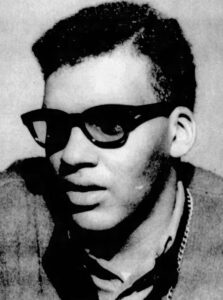
A featured piece in the Louisville Defender in the Spring of 1966 mentions the pending publication by Lexington’s Griffin Press of a book of poetry from Jones – A Horizontal Fall. Of course, it also mentions his touring with The Soul Brothers until he “re-enters the University of Kentucky in the summer.” Those shows at local venues the Elks Club and Paradise Inn were a great chance to unwind with some rock and rhythm n’ blues.
It would not be long, however, before Jones was back to his jazz passions. The timing was perfect to re-team with Clarence Martin, who Jones had played with occasionally as part of a loose quartet back in 1963.
Clarence Martin had been on the jazz scene for years. He had taught music in nearby Paris prior to school consolidation when he was given the heave-ho and ended up in Lexington teaching Special Education at the Kentucky Village. Day jobs don’t count – his real work was on the tenor and soprano saxophones and the flute. He started the Jazz Gents in ’58 and at least one of his early appearances was backing Roland Kirk at Lexington’s Cotton Club. Now fresh from an extended engagement at the Climax Café in New Albany, Indiana, supporting Mary Ann Fisher – Martin was ready to cook!
Martin’s new band was the Fourth Dimension and Marshall Jones was the obvious addition on the electric organ. Drummer Darnell Watkins and guitarist Jesse Gonzales were old friends of Martin’s and took a shine to Jones from the onset. Besides shows in Louisville and Cincinnati, the quartet mixed in local gigs at Club Hurricane on Deweese St, which was operated by Martin.
Meanwhile in town, Ed Commons had Chetwyd Records up and running and he would be the perfect man to capture the group on vinyl. Commons was a recent transplant from Pittsburgh where he had been an actor and sound technician among other things. He was far more than just a knob turner. Locally known for his “Off the Record” newspaper column reviewing the latest platters and his job as the manager of the record department at Barney Miller’s, Commons breathed music. A true “long hair”, Ed was fully ingrained in the local music scene and was quick to pull the Fourth Dimension under his managerial umbrella. His stable of recorded talent would ultimately range from garage rockers One of Hours to the vocal group Pepper & The Shakers to folkies Pat & Barbara and many others.
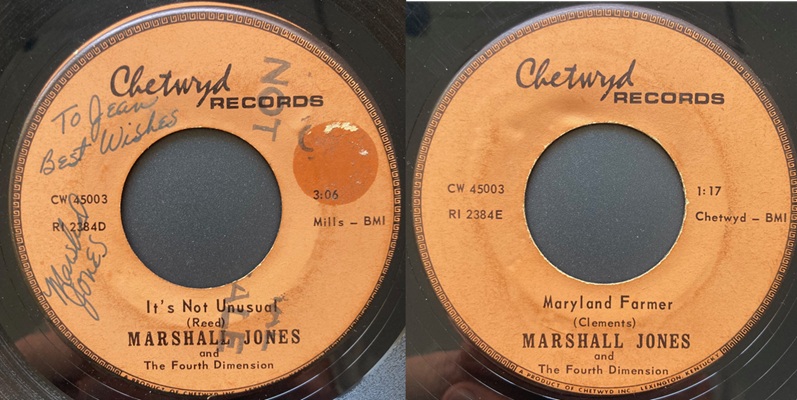
Though the Fourth Dimension often backed vocalists (heck, even Ed had appeared with them), the 1967 session for Chetwyd would consist of pure instrumentals. Commons had the ear and despite the small studio the end result is a great snapshot of the band.
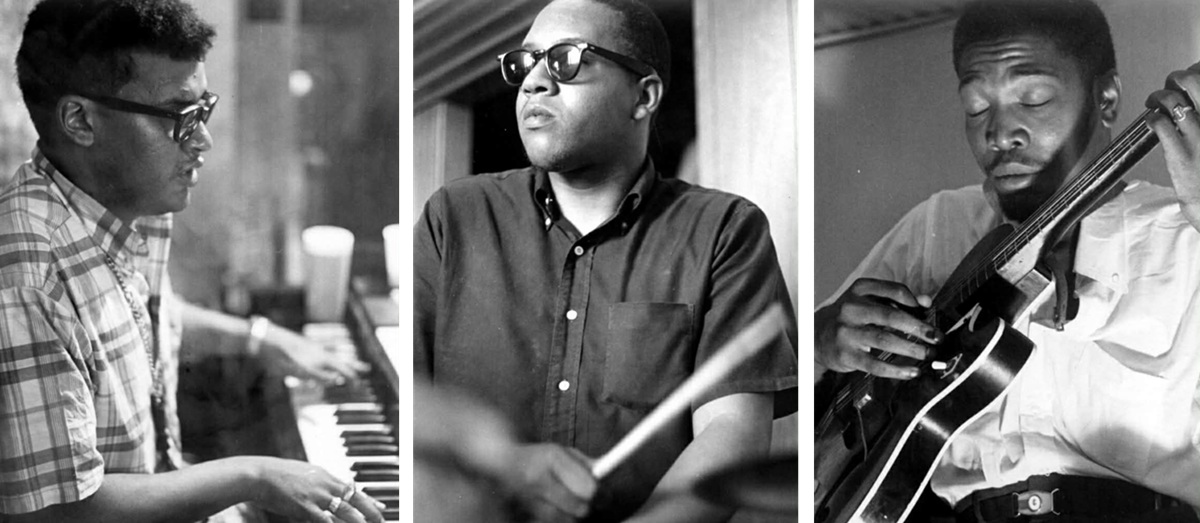
The A-side cover of “It’s Not Unusual” is a swinging affair of the Les Reed / Gordon Mills composition, which had been a worldwide smash for Tom Jones just a couple of years prior. Clarence managed to duck the studio photos that Ed Commons so artfully arranged, but his flute appears prominently on the track. The “voice” of the flute and Marshall’s keys ping-pong off each other nicely. At the halfway point, the band starts to feel it, and the listener does as well. Gonzales’ guitar is met with some nice flourishes by Jones and the boys are clearly just riffing and enjoying themselves.
The flip “Maryland Farmer” is a bit of a mystery. Sonically it is not the same cut made popular by the Bob Wilber Quintet with Clark Terry. With Commons holding the publishing rights it would seem to be an original, but the name credited is a mystery or a pseudonym. It can only be speculated, but maybe the guys were having a bit of fun with the title as that was also ‘60s slang for another certain “M.F.” term. Here the band embrace their name by condensing musical space-time to just over a minute. But what a fun burst! Just one more dance before last call, make ‘em sweaty and ready to down a cold beer at the bar. This track would have been at home in nearly any dance club spot and shows why the guys were in demand.
The record apparently didn’t make much of a regional splash given its scarcity these many years later, but it certainly opened doors. The band was praised by the Herald-Leader’s John Alexander for their January 1968 extended stay at Lexington’s Jockey Club noting that Jones “does a most unusual job either as a soloist or as part of a duet when Clarence plays the flute.”
Full of boundless energy, Jones was still sitting in for late night jam sessions and established gigs. He appeared with drummer Tag Veal and his namesake Trio at the Jockey Club in February and then in April with the Fourth Dimension backing Teddy Hill (who was coming off his soulful release of “I Just Dropped In”).
It is impossible to forget the cultural change in America at that time. Just days prior to the band’s gig with Hill, Martin Luther King was assassinated – the Civil Rights Act was passed less than a week after his death. Campus protests and riots were both national and local. Jones felt the pull and was fully engaged on the University of Kentucky campus in 1969.
His sociology studies and leadership abilities landed him the role of President of UK’s Black Student Union. Under his guidance the campus hosted the first Black Arts Festival, and it was followed by a well-attended dance at the student center with the Fourth Dimension providing the music.
Ever since the UK men’s basketball squad were defeated by an all-black Texas Western five in the 1966 NCAA championship, there had been grumblings that the University was not doing enough to attract black athletes. Jones took the opposite tack and pushed the BSU direction towards attracting black students and NOT athletes:
…we are trying to de-emphasize the sports thing – we realize that this is an educational institution, and we will mainly encourage enrollment of black students of academic merit. What we are striving for is educational relevancy and more community involvement.¹
Beyond campus, the music would continue to pull his heart. His old Fourth Dimension bandmate Darnell Watkins had assumed managerial duties at the newly revamped La Flame supper club and Jones made several appearances with Lexington’s legendary jazz saxophonist Duke Madison backing the lovely “Miss Versatility” Gina Dee.
He formed his own Trio again and took up residence at 803 South. Dubbed “House of the Unusual” (sense a theme yet?), Jones would have had plenty of time to pal with Winston Walls and other greats who passed through the doors of the Broadway club.
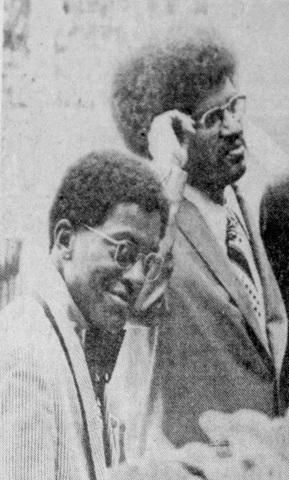
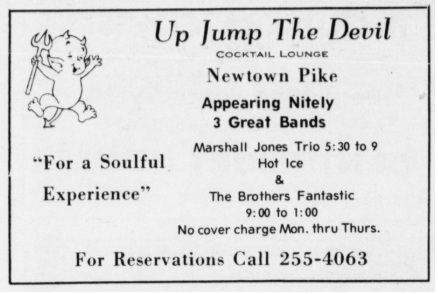
His talents were well distributed around clubs and groups in the mid-1970s. Just a sample of gigs include Up Jump the Devil, jam sessions with ex-Torque Phil Copeland at The Night Life, appearances at O’K’eefe’s with Paul Million and Slim Jackson, The Place alongside Jeff Thomas, Kouf’s Restaurant…
The thread tracing Marshall’s path is gossamer fine by the end of the 1970s. There wasn’t much keeping Jones tethered to Lexington. His mother had passed away in 1972 and both siblings had moved out of state. For reasons unknown, Jones ended up in St Louis, Missouri. Given the rich musical history of the River City, it could have certainly been to pursue a new musical direction. He died there from an apparent heart attack in August 1984 at age 42.
Discography:
Chetwyd 45003 It’s Not Unusual / Maryland Farmer 1967
¹ Kentucky Kernel, Feb 19, 1969
Support Lexingtunes and keep Central KY’s musical past alive!